

Blogs
Australia Visa success rate in Nepal 2026

Overall Visa Grant rate overview 2025-2026
The chart clearly indicates a shift in Australia’s student visa assessment approach, reflecting the Department of Home Affairs’ increasing focus on genuine students and risk management.
Between 2019–2022, visa grant rates for Higher Education (HE) and Research programs remained consistently high (often above 90%), showing strong confidence in students pursuing university-level and research-based studies. However, from 2022–2024, there is a sharp decline in grant rates—particularly in the VET sector, where approvals dropped significantly (as low as ~10–20%). This suggests tighter scrutiny due to concerns around non-genuine students, course hopping, and migration-driven applications.
In contrast, Research visa grant rates remain near 100% throughout, indicating that Australia continues to prioritize high-quality, academically committed students. From 2024–2026, a recovery trend is visible, especially in Higher Education and overall grant rates, reflecting improved application quality and stricter compliance measures.
Students planning to study in Australia from Nepal must now be more strategic than ever. Choosing the right course, preparing strong documentation, and aligning with genuine study intentions are critical for visa success. Fund must be genuinely assessible to student for their study and living expenses.
| Australia Visa grant rate from Nepal 2026 | ||||
| Year | HE Visa grant % | VET Visa Grant % | Research Visa Grant % | Overall Visa Grant rate |
| 2019-2020 | 82.80 | 33.50 | 100.00 | 76.20 |
| 2020-2021 | 87.80 | 50.50 | 97.20 | 78.80 |
| 2021-2022 | 93.00 | 70.90 | 95.70 | 83.70 |
| 2022-2023 | 65.20 | 14.20 | 100.00 | 53.90 |
| 2023-2024 | 56.00 | 8.60 | 99.20 | 55.60 |
| 2024-2025 | 93.60 | 43.30 | 97.70 | 92.10 |
| 2025-2026 | 67.90 | 35.80 | 73.90 | 63.40 |
Australia Student Visa Grant from Nepal
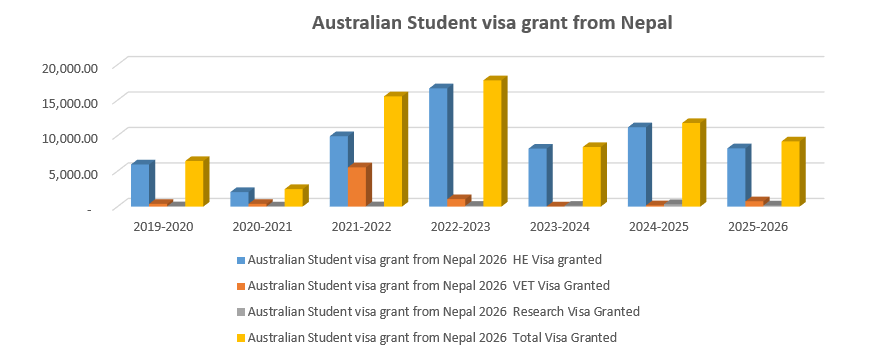
Strategically, Higher Education remains the most reliable pathway, consistently contributing the highest number of approvals, while the VET sector has faced significant declines due to stricter scrutiny. Research visas, although low in number, maintain near-perfect approval rates, reinforcing Australia’s focus on academically serious candidates. Overall, the trend confirms a “quality over quantity” approach, meaning students from Nepal must now focus on strong documentation, course relevance, and genuine study intent to succeed.
During that period, the Department of Home Affairs intensified its verification process by issuing Requests for Further Information (S26) on many student visa applications. Applicants were asked to provide additional supporting documents to validate the authenticity of their financial capacity, academic background, and Genuine Student claims.
As a result, students who failed to submit sufficient, consistent, and verifiable evidence faced higher refusal rates. This clearly indicates that DHA adopted a strict document verification approach, where incomplete or questionable documentation directly led to visa rejections, reinforcing the importance of strong and credible application preparation.
| Australian Student visa grant from Nepal 2026 | ||||
| Year | HE Visa granted | VET Visa Granted | Research Visa Granted | Total Visa Granted |
| 2019-2020 | 5,943.00 | 385.00 | 45.00 | 6,429.00 |
| 2020-2021 | 2,050.00 | 385.00 | 35.00 | 2,471.00 |
| 2021-2022 | 9,929.00 | 5,535.00 | 45.00 | 15,541.00 |
| 2022-2023 | 16,670.00 | 1,056.00 | 109.00 | 17,800.00 |
| 2023-2024 | 8,174.00 | 26.00 | 124.00 | 8,400.00 |
| 2024-2025 | 11,184.00 | 178.00 | 344.00 | 11,785.00 |
| 2025-2026 | 8,213.00 | 757.00 | 164.00 | 9,192.00 |
Australia Student Visa lodged from Nepal
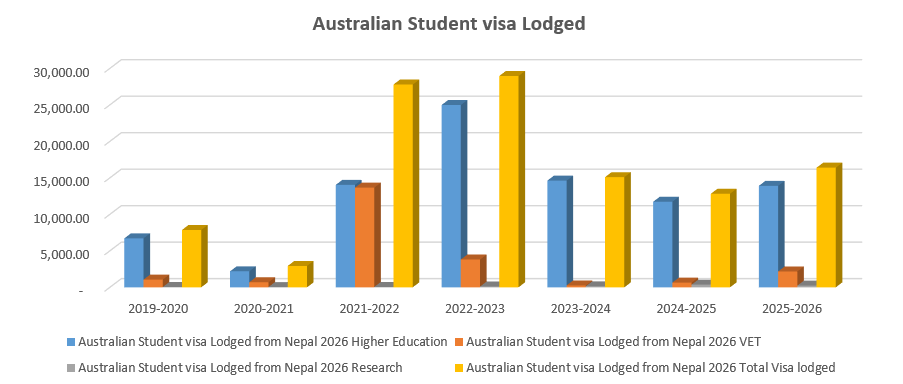
The data clearly shows that while interest in studying in Australia from Nepal reached its peak in 2022–2023, the surge in applications led to increased scrutiny and a decline in visa approvals. The Department of Home Affairs responded by tightening document verification and focusing on genuine students, ensuring that only applicants with strong academic background, clear career pathways, and credible financial evidence were granted visas.
This shift sends a strong message: success is no longer about applying more, but applying right. Students who prepare complete, authentic, and well-structured applications now have a significantly higher chance of approval. With expert guidance and proper planning, Australia remains one of the most achievable and rewarding destinations for Nepalese students.
| Australian Student visa Lodged from Nepal 2026 | ||||
| Year | Higher Education | VET | Research | Total Visa lodged |
| 2019-2020 | 6,716.00 | 1,059.00 | 47.00 | 7,859.00 |
| 2020-2021 | 2,199.00 | 695.00 | 37.00 | 2,932.00 |
| 2021-2022 | 14,043.00 | 13,661.00 | 50.00 | 27,792.00 |
| 2022-2023 | 24,981.00 | 3,812.00 | 112.00 | 28,957.00 |
| 2023-2024 | 14,620.00 | 254.00 | 142.00 | 15,096.00 |
| 2024-2025 | 11,729.00 | 648.00 | 364.00 | 12,827.00 |
| 2025-2026 | 13,909.00 | 2,177.00 | 242.00 | 16,399.00 |
Australia Visa for Higher Education

The data clearly proves that Higher Education is the most dependable and successful pathway for Nepalese students applying for an Australia student visa. Even during the peak in 2022–2023, when applications surged dramatically, a significant proportion of students in bachelor’s and master’s programs continued to receive approvals. This reflects the strong confidence the Department of Home Affairs (DHA) places in university-level education compared to other sectors.
What’s equally important is the policy shift seen in recent years. In 2025, Nepal was briefly moved to Level 2, which made the visa process comparatively easier and led to a rise in applications, including some with weaker or insufficient documentation. However, due to increasing concerns around document authenticity and fraud, DHA reclassified Nepal back to Level 3 in January 2026, reinforcing stricter verification and evidentiary requirements. This clearly signals that Australia is prioritizing genuine, well-documented applicants, and students who present strong academic intent, credible financial evidence, and complete documentation now have a significantly higher chance of visa success.
| Australia Visa for Higher Education from Nepal 2026 | |||
| Year | Lodged | Granted | Overall Visa Grant rate |
| 2019-2020 | 6,716.00 | 5,943.00 | 82.80 |
| 2020-2021 | 2,199.00 | 2,050.00 | 87.80 |
| 2021-2022 | 14,043.00 | 9,929.00 | 93.00 |
| 2022-2023 | 24,981.00 | 16,670.00 | 65.20 |
| 2023-2024 | 14,620.00 | 8,174.00 | 56.00 |
| 2024-2025 | 11,729.00 | 11,184.00 | 93.60 |
| 2025-2026 | 13,909.00 | 8,213.00 | 67.90 |
Australia Student Visa for VET from Nepal
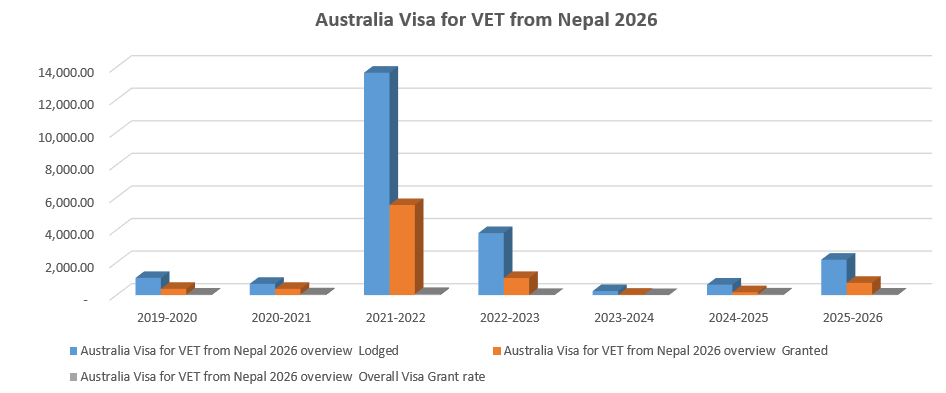
The data clearly shows that the VET pathway has become more challenging and high-risk for Nepalese students. After a surge in 2021–2022, visa approvals dropped significantly due to the Department of Home Affairs tightening scrutiny on non-genuine applications and misuse of the VET sector.
Rather than choosing generic VET programs, it is advisable to select high-demand and skill-shortage fields such as Nursing, Early Childhood Education, Construction, or Automotive, where study pathways align with real career outcomes. Additionally, VET should be a logical choice based on a student’s academic background and progression—not an alternative for those already qualified for university-level study without clear justification. A well-aligned course choice, supported by strong documentation and genuine intent, is now essential for visa success.
| Australia Visa for VET from Nepal 2026 overview | |||
| Year | Lodged | Granted | Overall Visa Grant rate |
| 2019-2020 | 1,059.00 | 385.00 | 33.50 |
| 2020-2021 | 695.00 | 385.00 | 50.50 |
| 2021-2022 | 13,661.00 | 5,535.00 | 70.90 |
| 2022-2023 | 3,812.00 | 1,056.00 | 14.20 |
| 2023-2024 | 254.00 | 26.00 | 8.60 |
| 2024-2025 | 648.00 | 178.00 | 43.30 |
| 2025-2026 | 2,177.00 | 757.00 | 35.80 |
Australia Student Visa for Research from Nepal
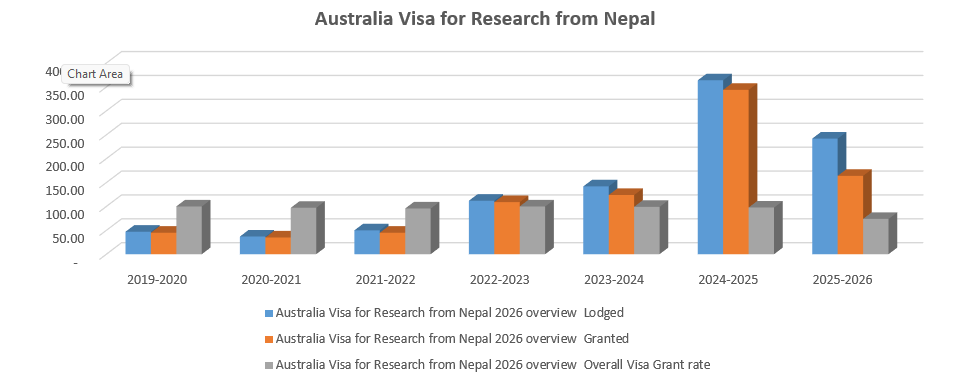
The data clearly shows that Research programs are the most secure and high-success pathway for Nepalese students applying for an Australia student visa. Although application numbers are relatively low, approvals consistently remain high, with grants closely matching lodgements—demonstrating the strong confidence the Department of Home Affairs places in academically driven, research-focused applicants.
However, in 2025–2026, research applications declined, likely due to students shifting toward programs with clearer career or migration pathways, as well as some applying without genuine research interest assuming near-certain visa approval. Despite this, research remains one of the most trusted and reliable options for students with strong academic backgrounds and genuine intent, offering a significantly higher chance of visa success.
| Australia Visa for Research from Nepal 2026 overview | |||
| Year | Lodged | Granted | Overall Visa Grant rate |
| 2019-2020 | 47.00 | 45.00 | 100.00 |
| 2020-2021 | 37.00 | 35.00 | 97.20 |
| 2021-2022 | 50.00 | 45.00 | 95.70 |
| 2022-2023 | 112.00 | 109.00 | 100.00 |
| 2023-2024 | 142.00 | 124.00 | 99.20 |
| 2024-2025 | 364.00 | 344.00 | 97.70 |
| 2025-2026 | 242.00 | 164.00 | 73.90 |
Frequently asked questions
Australia's research degree is so much popular programs for International Students. However, few education providers are also accepting application specially for Management students with not research intend students. These student are only applying to get visa grant and education agents are also counselling on this same background. DHA also found students changing providers once they arrive in Australia.
If students enter Australia under the student visa programme but fail to attend classes or complete their qualifications, it undermines the integrity and overall value of Australia’s international education sector. DHA has more concern about the poor quantity of applications submitted from Nepal over the past few months.
Visa officers assess applications across 3 key areas: 1. Home Country Situation: Economic ties, return incentives 2. Potential in Australia: Realistic study/living plan 3. Value of Course: Alignment with future career Visa decisions are increasingly based on whether an applicant’s study plan is realistic, economically justified, and personally credible- not just whether documents are complete. Decision-makers assess an applicant’s home circumstances to determine their genuine intentions and overall risk. This includes whether there are suitable employment opportunities in Nepal related to their field of study, whether their qualifications will be recognized, and whether they are likely to return or attempt to remain in Australia or move to another country after completing their studies. They also evaluate the applicant’s proposed living and study arrangements in Australia. A clear, realistic plan that demonstrates preparedness for accommodation, expenses, and academic commitment helps strengthen credibility, while vague or unrealistic plans can raise concerns about the applicant’s genuine student intentions. They want to know how their chosen course aligns with their future career plans and return on investment. Popular cities like Sydney and Melbourne are very expensive, and visa officers want to see if a student can realistically afford to live there or has a particular plan for study and living costs for their study period.


